





Neutral Lactase Enzyme Buying Guide: How to Choose the Right Enzyme for Dairy Processing
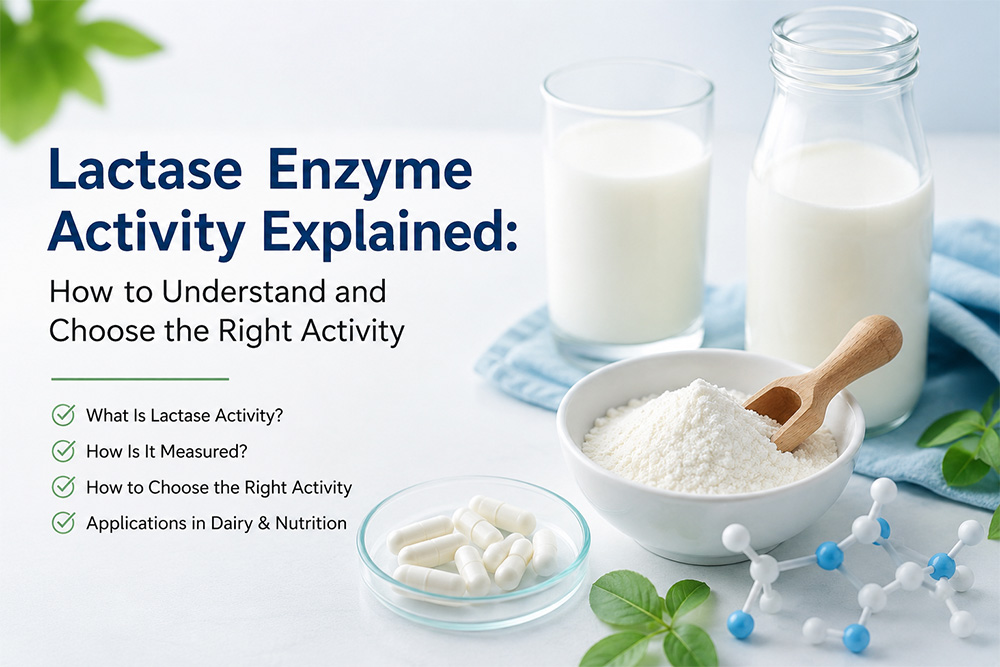
Choosing the right neutral lactase enzyme is an important step for manufacturers developing lactose-reduced and lactose-free dairy products. However, selecting a suitable enzyme requires more than comparing activity values or price per kilogram. Processing conditions, pH, temperature, reaction time, and product requirements all need to be considered.
For dairy manufacturers and ingredient buyers, understanding these factors can support more informed sourcing decisions and help identify an enzyme specification that fits their production process. In this guide, we explore the key considerations when purchasing neutral lactase enzyme for dairy processing.
1. What Is Neutral Lactase Enzyme?
Lactase, also known as β-galactosidase or β-D-galactoside galactohydrolase, catalyzes the breakdown of lactose into one molecule of glucose and one molecule of galactose. Meanwhile, lactase also exhibits transgalactosylation activity.
Neutral lactase has an optimum pH range of 6.0–7.0 and is derived from Kluyveromyces lactis. It delivers the highest activity in neutral dairy products such as milk and is widely applied in the industrial production of low-lactose milk and liquid dairy products.
2. Why Is Neutral Lactase Used in Dairy Processing?
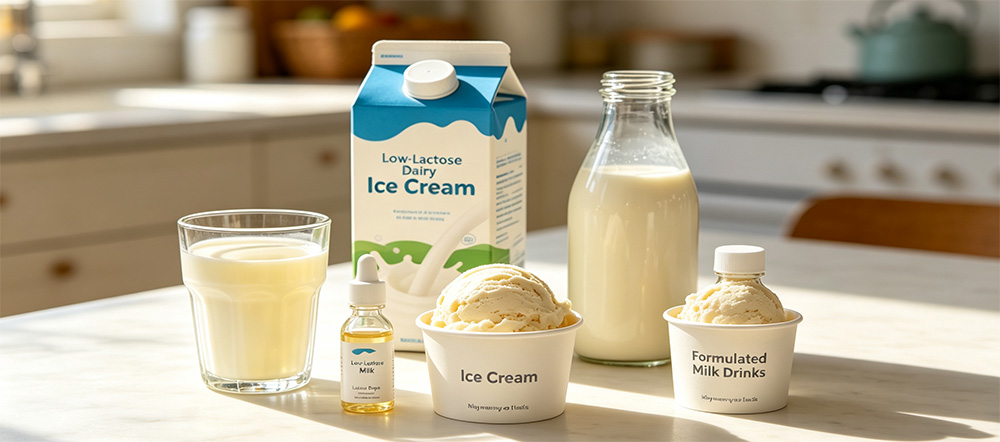
Neutral lactase is preferred in dairy processing because milk has a near-neutral pH, which closely matches the optimal pH range of neutral lactase for higher hydrolysis efficiency. When added during dairy production, it breaks down lactose into glucose and galactose to make low-lactose or lactose-free products, so people with lactose intolerance can consume dairy safely. Lactose hydrolysis also brings a natural sweet taste, cutting down the need for extra sugar. Besides, the enzyme can be quickly deactivated in the subsequent heating process. This allows manufacturers to precisely control the degree of hydrolysis and prevent unwanted flavour changes. It works well in production lines for liquid milk, milk powder, ice cream and other dairy products.
3. Key Factors When Choosing Neutral Lactase Enzyme
When choosing a neutral lactase enzyme, buyers should consider:
- Enzyme Activity: Choose the right activity based on the product and required lactose reduction. Standard Specifications: 2500 NLU/g, 5000 NLU/g
- PH & Temperature: Optimal pH: 6–7, Optimal temperature: 30–40°C
- Application: Make sure the lactase is suitable for milk, yogurt, ice cream, whey, or other dairy products.
- Dosage: Compare recommended dosage and cost per batch, not only the price per kg.
- Quality & Documentation: Check COA, TDS, MSDS, food-grade certification, and other required documents.
- Supply Stability: Consider MOQ, lead time, production capacity, and batch-to-batch consistency.
Choosing the right neutral lactase enzyme can help improve lactose hydrolysis and support consistent dairy processing results.
4. Neutral Lactase Enzyme vs. Acid lactase
ACID LACTASE
Activity: 160,000ALU/g Max, FCC method
Acid lactase is fermented from Aspergillus oryzae, Activity is expressed by ALU/g ,it is in white~deep brown power forms, normal use in milk powder( include sweetened milk powder ) , cream powder and the recombined products ,Medicines and Health Products etc. Acid lactase is react in the body the Optimum temperature 50~55℃,the optimum pH 5.0.
Dosage in powder milk: 0.1~0.3%(10,000ALU/g)
Dosage in Modified milk powder: 0.4~0.6%(100,000ALU/g)
NEUTRAL LACTASE
Activity: 2500NLU/g 5,000NLU/g, FCC method
Neural lactase is fermented from Kluyveromyces lactis, Activity is expressed by NLU/g,it is in colorless ~deep brown liquid. Normal use in liquid milk.
Dosage recommendation depends on below conditions:
1. Milk composition including fat and lactose concentration
2. Desired level of lactose in final product
3. Batch processing conditions(hydrolysis time and temperature)
4. Post-packaging conditions after in-line dosing(storage time and temperature)
For dairy processing, buyers should choose the lactase enzyme according to the product’s pH, processing temperature, dosage, and target lactose reduction.
5. What to Check When Buying Neutral Lactase from a Supplier
When purchasing neutral lactase, buyers should follow a complete checklist. It is necessary to verify product specifications and enzyme activity test methods, obtain COA and technical documents, and confirm batch consistency. Buyers also need to check packaging & storage requirements, MOQ and lead time, and conduct sample evaluation to fully assess the supplier’s product quality and delivery capability.
With 20 years of experience in raw material supply, lactase enzymes are one of our key product lines. If you are looking for the right enzyme for your formulation, please feel free to contact us. We are happy to provide more information and technical support.
E-mail: sales@sxshine.com
Whatsapp: +86 13324591225